









 BLOGS
 NEWSROOM
 CASE STUDIES
 WEBINARS
 PODCASTS
 ASSET HUB
 EVENT CALENDAR












Configurable Data Models
Add specialty-specific fields, order sets, and documentation templates without a platform limitation forcing a workaround.

FHIR-native EHRs built around your workflows and connected to Epic, labs, e-prescribing and devices. You own the code and the data.
Three ways to get there: buy off the shelf, build on a platform, or build from scratch. Compare the trade-offs.
In a customizable EHR, the data model, clinical workflows and integrations change on your release schedule.
Add specialty-specific fields, order sets, and documentation templates without a platform limitation forcing a workaround.
Clinical and admin workflows follow how your team actually works, step for step.
Connect labs, payers, wearables and billing systems on your timeline.
You decide what ships next, so the roadmap stays yours after go-live.
Every build covers four layers. We size each one to your care setting.

We build on headless FHIR platforms, or from scratch when the data model is yours alone. Compare headless EHR platforms. On Healthie, we extend intake, referral, billing and care-plan workflows through its API; see how Healthie compares.

Ambient documentation drafts the note during the visit, and the clinician approves it before it's written to the chart, with coding suggestions for ICD-10 diagnosis codes and CPT procedure codes in the same review step. We build AI actions into the same audit trail as clinician actions.

Order sets, documentation templates, care plans and registry reporting follow your specialty's clinical logic, and we build EHRs for fertility clinics, multi-specialty groups and home health and rehabilitation.

We integrate with Epic, Oracle Health and athenahealth over FHIR, HL7 and SMART on FHIR. Mindbowser is an Epic Vendor Services member.
Tell us your workflows and the systems your EHR has to connect to. We'll map the build route with you.
Zero extra clicks to launch from Epic. 30+ minutes saved per shift handoff.
Read MoreBuilt a connected care platform with real-time vitals from Bluetooth devices, care manager dashboards, CPT-based billing, and patient-facing mobile apps.
Read MoreRecommends tests from patient data and configurable clinical logic, with separate views for hospitals, individual providers and admins.
Read MoreWe start with a six-week discovery phase, mapping clinical workflows, user roles, and system requirements. Your clinical team reviews a working prototype, while compliance and security requirements guide the design from day one, helping prevent costly changes during development.
We build your custom EHR in structured sprints, following your chosen development approach, whether using a FHIR-based platform or building from scratch. Each sprint focuses on delivering secure, scalable functionality aligned with your clinical workflows and operational requirements.
We connect your EHR with essential healthcare systems and validate workflows, integrations, and data migration before launch. For legacy EHR transitions, we plan a 30–90-day read-only period based on your organization's data retention, compliance, and audit requirements.
We deploy your custom EHR within your preferred infrastructure, ensuring a smooth transition from development to production. Our team supports go-live activities, monitors system performance, resolves technical issues, and provides ongoing assistance to keep your clinical operations running efficiently.
See how custom, AI-driven systems are cutting costs and improving care at scale.
We don’t just deliver solutions we build partnerships that drive transformation. With a proven track record in healthcare technology, we understand the industry’s unique challenges and offer customized solutions to help you achieve breakthroughs.

Deep healthcare knowledge ensures technology aligns with real-world clinical workflows, driving impact.

Pre-built components help you get to market quickly.

AI models are trained on your local data in your secure cloud environment.

Proven integrations ensure dependable connectivity with EHRs, payers, and digital health platforms.

Delivered 50+ healthcare solutions across 10+ countries, covering a diverse range of healthcare needs.

Faster development by implementing customized solutions for every challenge.

We deliver 100% ownership of IP and code, so your systems stay connected without vendor lock-in.

Ensure reliable integration with your systems and scalability to adapt to evolving needs.

Our 50+ prebuilt frameworks accelerate the development process and reduce time-to-market by 30%.

The specialized AI tools are customized to address healthcare challenges and clinical workflows.

Stay informed with our hub, offering insights and thought leadership to support your team.

A user-centric approach ensuring smooth adoption and superior experience.

Use automation to boost efficiency and enhance care quality.

Our clear, open pricing ensures you understand your investment without hidden costs or surprises.

A quick look at how we help organizations transform ideas into outcomes.
See how a Labor & Delivery AI platform integrated with Epic to predict delivery timing, reduce coding denials, and improve hospital workflows.
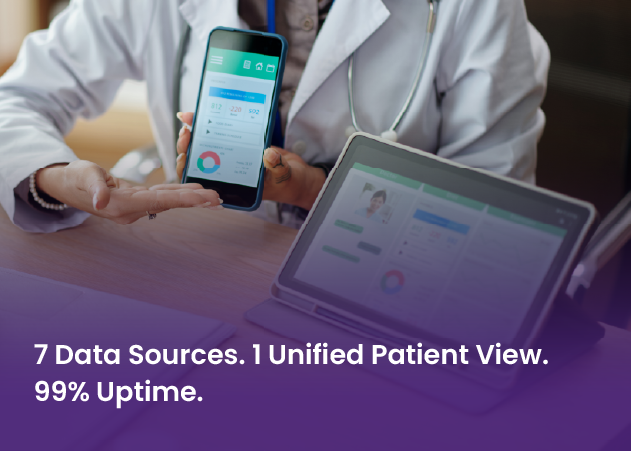
See how a behavioral health network unified 7 data sources into one patient dashboard with 15 clinical cards, 99% uptime, and vendor independence.
From leading hospitals to digital-health companies, Mindbowser powers real-world healthcare transformation.









HIPAA-ready builds with controlled PHI access, secure environments, and disciplined engineering practices. Designed to reduce vendor risk and speed up onboarding.

Independent audit of security controls operating over time.

PHI safeguards built into access, environments, and release workflows.

Data handling built for modern privacy expectations.

Role-based access with controlled PHI exposure.

Code reviews, dependency checks, and security gates.

Secure integrations designed for traceability and reliability.

 Encryption in transit and at rest
 Role-based access and least privilege
 Secure SDLC with code reviews
 Pen testing based on scope and risk
Collaborating with Industry Leaders for Smarter Healthcare





On a FHIR platform, an initial platform can be live in under 90 days. A full-featured, enterprise-grade EHR typically takes 12-24 months, depending on integrations and compliance validation. If you certify your own product, plan for twelve to eighteen months on top.
Cost depends on the build route. Building on a FHIR platform usually costs less and goes live sooner than building from scratch, and off-the-shelf EHRs are billed as a subscription. But certifying your EHR is a separate step: scope it from day one. Our EHR software cost guide breaks down typical ranges for each route. Headless builds are typically faster and lower-cost than ground-up custom platforms.
If your EHR is intended for use in a certified health IT environment or for Meaningful Use reporting, ONC 2015 Edition certification (updated via HTI-1) is required. Point-of-care tools and internal clinical apps often don't require certification, but they must still meet HIPAA. Information-blocking rules apply to the actors listed in 45 CFR 171.102: health care providers, developers of certified health IT, and health information networks or exchanges. Check whether your organization is one of them.
Yes. We work across three models: extending commercial EHRs (Epic, Cerner, eCW) via SMART on FHIR apps and APIs; building headless EHRs on platform backends (OpenEMR, Canvas Medical, Oystehr); and building fully custom platforms from the ground up. The right model also depends on your USCDI v3 data-class coverage requirements.
A custom EHR is a purpose-built clinical records platform designed for a specific care setting or workflow. A headless EHR uses an open-source FHIR backend as the data and API layer, with a custom user interface and workflow layer built on top. Headless EHR development is typically faster and less expensive, while a fully custom EHR provides greater control over data models, architecture, and compliance. Our headless EHR comparison breaks down each platform, and our guide to choosing between a ready-made and custom build covers the decision.
Partner with us to design, build, and scale digital solutions that drive better outcomes.
Global Tech Teams LLC, 525 Washington Blvd, Industrious at Newport Tower, Jersey City, NJ 07310, United States.
Let’s discuss your goals, workflows, and next steps in a focused consultation call.
 Schedule a Call